
A charge air cooler is a critical component in turbocharged engines, cooling compressed air before it enters the engine to improve combustion efficiency, increase power output, and reduce emissions. At AMI Exchangers, we specialise in designing, manufacturing, and servicing charge air coolers for marine, industrial, and rail applications — delivering reliable cooling solutions that keep your engines performing at their peak.
WHAT IS A CHARGE AIR COOLER?
A charge air cooler, also known as an intercooler or aftercooler, is a heat exchanger that cools the hot, compressed air generated by a turbocharger or supercharger before it enters the engine’s combustion chambers. This cooling process is essential for maximising engine performance and efficiency.
How Charge Air Coolers Work:
1. COMPRESSION — The turbocharger draws in ambient air and compresses it, significantly increasing its temperature (often exceeding 200°C)
2. COOLING — The hot compressed air passes through the charge air cooler, where heat is transferred to a cooling medium (engine coolant, seawater, or ambient air)
3. INTAKE — The cooled, denser air enters the engine cylinders, allowing more fuel to be burned efficiently and generating more power
Why Cooling Matters:
Cooling the intake air increases its density, meaning more oxygen molecules occupy the same volume. This denser air-fuel mixture burns more completely, delivering:
• Increased engine power output
• Improved fuel efficiency
• Reduced exhaust emissions
• Lower exhaust gas temperatures
• Extended engine component life
CHARGE AIR COOLER VS INTERCOOLER:
WHAT'S THE DIFFERENCE?
The terms “charge air cooler” and “intercooler” are often used interchangeably, leading to confusion. Here’s the technical distinction:
INTERCOOLER
Originally referred to coolers positioned between multiple stages of compression in multi-stage turbocharger systems. The prefix “inter-” means “between.”
CHARGE AIR COOLER
The broader, more technically accurate term for any cooler that cools the intake air charge after compression and before it enters the engine. This includes:
• Air-to-air coolers (ambient air cooling)
• Air-to-liquid coolers (engine coolant or seawater)
• Aftercoolers (positioned after the final compression stage)
In modern usage, “charge air cooler” is the preferred industrial term, particularly in marine and heavy-duty applications, while “intercooler” remains common in automotive and motorsport contexts. At AMI Exchangers, we design and manufacture both configurations to suit your specific application.
HOW CHARGE AIR COOLERS IMPROVE ENGINE PERFORMANCE
The benefits of effective charge air cooling extend across every aspect of engine operation:
INCREASED POWER OUTPUT
Cooler intake air is denser, containing more oxygen per unit volume. This allows the engine management system to inject more fuel while maintaining optimal air-fuel ratios, directly increasing power output. Effective cooling can improve power by 10-15% compared to uncooled turbocharged operation.
IMPROVED FUEL EFFICIENCY
Complete combustion of the denser air-fuel mixture extracts more energy from each drop of fuel. This translates to reduced fuel consumption per unit of work performed — critical for marine vessels undertaking long voyages and industrial equipment operating continuously.
REDUCED EMISSIONS
Complete combustion produces less unburned hydrocarbons, carbon monoxide, and particulate matter. For engines operating in regulated environments, effective charge air cooling helps meet increasingly stringent emissions standards.
EXTENDED ENGINE LIFE
Lower intake temperatures reduce thermal stress on pistons, rings, valves, and cylinder heads. Cooler combustion also reduces the formation of harmful nitrogen oxides (NOx), which can accelerate engine wear and oil degradation.
LOWER EXHAUST GAS TEMPERATURES
Cooler combustion produces lower exhaust temperatures, reducing thermal loading on exhaust valves, turbocharger turbines, and exhaust system components. This extends service intervals and reduces maintenance costs.
SIGNS YOUR CHARGE AIR COOLER NEEDS REPLACEMENT
Recognising charge air cooler failure early prevents costly engine damage and unplanned downtime. Watch for these warning signs:
LOSS OF POWER UNDER LOAD
A failing cooler cannot effectively reduce intake air temperatures, resulting in less dense air and reduced combustion efficiency. You may notice reduced acceleration, difficulty maintaining speed under load, or inability to reach rated power output.
LOW BOOST OR BOOST DROP
If the cooler core is leaking, compressed air escapes before reaching the engine, causing the turbocharger to work harder while delivering less boost pressure. This manifests as sluggish throttle response and reduced performance.
INCREASED EXHAUST GAS TEMPERATURES (EGT)
Higher-than-normal exhaust temperatures indicate inefficient combustion, often caused by inadequate intake air cooling. Continuous operation at elevated EGTs risks piston, ring, and valve damage.
POOR FUEL ECONOMY
Incomplete combustion due to hot intake air wastes fuel. A sudden increase in fuel consumption without changes in operating conditions suggests charge air cooler degradation.
EXCESSIVE BLACK SMOKE
Black exhaust smoke indicates incomplete combustion — often caused by insufficient oxygen delivery due to air leaks in the cooler or excessively hot intake air preventing proper fuel burning.
HISSING OR AIR ESCAPE SOUNDS
Audible air leaks from the charge air cooler housing, connections, or hoses indicate core damage or seal failure. These leaks reduce boost pressure and introduce contaminants.
OIL SEEPAGE ON CAC CORE
Oil coating the exterior of the charge air cooler core suggests internal damage allowing engine oil to enter the air stream. This contamination reduces cooling efficiency and can damage the turbocharger.
REPEATED DPF REGENERATIONS
For engines equipped with Diesel Particulate Filters (DPF), incomplete combustion caused by charge air cooler failure produces more soot, requiring more frequent regeneration cycles and increasing fuel consumption.
CHARGE AIR COOLER APPLICATIONS
Charge air coolers serve critical functions across diverse industries:
MARINE ENGINES
Ocean-going vessels, offshore platforms, and commercial shipping rely on charge air coolers for main propulsion and auxiliary power generation. Marine applications demand corrosion-resistant materials and robust construction to withstand saltwater environments and continuous operation.
INDUSTRIAL ENGINES
Power generation sets, compressor stations, and industrial machinery use charge air coolers to maintain consistent performance under varying loads. Industrial applications often prioritise reliability and serviceability over weight considerations.
RAIL LOCOMOTIVES
Diesel-electric and diesel-hydraulic locomotives depend on charge air cooling to deliver the power needed for traction. Rail applications require compact, robust coolers capable of withstanding vibration and shock loads.
HEAVY EQUIPMENT
Mining trucks, construction equipment, and agricultural machinery utilise charge air coolers to maximise productivity in demanding operating conditions. These applications emphasise durability and resistance to dust and debris.
AMI CHARGE AIR COOLER SOLUTIONS
MARINE & INDUSTRIAL SPECIALISTS
For over 30 years, AMI Exchangers has designed and manufactured charge air coolers for the world’s most demanding applications. Since 1987, we have supplied cooling solutions to marine operators, industrial facilities, and rail operators worldwide. Our Hartlepool manufacturing facility combines British engineering excellence with global reach.
Our NQA ISO 9001:2015 certification ensures consistent quality, while our TradeNet ID 52732 establishes us as a recognised supplier in international procurement systems.
ON-BOARD SERVICES WORLDWIDE
Unlike generalist suppliers, AMI Exchangers brings the workshop to you. Our mobile technical teams provide on-board services for ships and on-site services for industrial facilities across the globe:
• RE-TUBING AND RECORING — Restore damaged coolers to full performance
• EMERGENCY REPAIRS — Rapid response to minimise downtime
• ROUTINE MAINTENANCE — Scheduled servicing to prevent failures
• PRESSURE TESTING — Verify integrity and identify leaks
• PERFORMANCE TESTING — Ensure cooling efficiency
We understand that downtime costs money. Our worldwide service capability means we can reach your vessel or facility quickly, reducing operational disruption.
MATERIAL OPTIONS FOR EVERY APPLICATION
Different operating environments demand different materials. AMI Exchangers works with a comprehensive range of materials to optimise performance and longevity:
ALUMINIUM
Lightweight and cost-effective with good thermal conductivity. Ideal for applications where weight matters and corrosion resistance is less critical. Commonly used in automotive and light industrial applications.
COPPER
Excellent thermal transfer properties and natural antimicrobial characteristics. Copper offers superior cooling performance and durability in moderate environments.
STAINLESS STEEL
Outstanding corrosion resistance for aggressive environments. Essential for marine applications, chemical processing, and any installation where longevity is paramount. Our stainless steel coolers withstand saltwater, chemical exposure, and temperature cycling.
CARBON STEEL
High strength and cost-effectiveness for industrial applications. Carbon steel provides robust construction for heavy-duty installations where weight is less critical than durability.Our engineers help you select the optimal material for your specific operating conditions, balancing performance, longevity, and cost.
CUSTOM ENGINEERING & REVERSE ENGINEERING
Standard products don’t always meet unique requirements. AMI Exchangers offers bespoke design services:
• BESPOKE DESIGNS — Custom dimensions and specifications
• REVERSE ENGINEERING — Replicate obsolete or discontinued units
• PERFORMANCE UPGRADES — Improve cooling capacity beyond original specification
• RETROFIT SOLUTIONS — Replace coolers in existing installations
• SPACE-CONSTRAINED APPLICATIONS — Compact designs for tight machinery spaces
Our in-house design team uses advanced thermal calculation software to ensure every custom unit delivers the required performance.
CHARGE AIR COOLER REPLACEMENT & REPAIR SERVICES
WHEN TO REPLACE VS REPAIR
Not every failing charge air cooler requires complete replacement. Our technical team assesses each unit to determine the most cost-effective approach:
REPAIR WHEN:
• Tube blockages can be cleared
• External fins can be straightened or replaced
• Headers and connections can be resealed
• Core damage is localised and accessible
REPLACE WHEN:
• Core deterioration is widespread
• Internal tube corrosion is extensive
• Original performance cannot be restored
• Upgraded specification is required
OUR RE-TUBING PROCESS
For coolers with damaged tubes but sound structural components, re-tubing offers significant cost savings compared to replacement:
1. INSPECTION — Complete assessment of cooler condition
2. DISASSEMBLY — Removal of headers and extraction of damaged tubes
3. TUBE INSTALLATION — Precision fitting of replacement tubes
4. EXPANSION/WELDING — Secure tube-to-tube sheet joints
5. REASSEMBLY — Header replacement and seal installation
6. PRESSURE TESTING — Hydrostatic testing to verify integrity
7. PERFORMANCE VERIFICATION — Thermal testing where required
EMERGENCY BREAKDOWN RESPONSE
Equipment failures don’t follow schedules. AMI Exchangers provides emergency response for critical situations:
• 24/7 EMERGENCY CONTACT — Reach our technical team anytime
• RAPID MOBILISATION — Fast dispatch of service engineers
• STOCK UNITS — Immediate replacement from inventory
• WORLDWIDE COVERAGE — No location too remote
Performance
Due to the range of fin types available to us, we always have a fin option that will allow us to build an air cooler that has thermal specifications equal to or better than the original unit. Occasionally, clients are unhappy with the original air cooler performance and in these circumstances we can offer to build a new cooler with improved efficiency or reduced pressure drop. The dimensions of the air cooler can be obtained from our extensive database of drawings, surveys on-board or from samples sent to our workshops. We manufacture air coolers using high quality materials. We buy these materials in bulk direct from European suppliers. This enables us to better control the quality of materials. Our quality procedure includes full trace-ability of material and workmanship. The air cooler is checked at various stages of production ensuring quality throughout all areas of manufacture.
Compliance
The NOx emissions of your engine are effected by the condition of the charge air cooler. Vessels now need to prove that the air cooler manufacturer has offered a cooler with the same performance as the original. Our fin types have been tested at independent test facilities and results used within our complex thermal design software. If we are supplied with the original thermal data, we can offer accurate thermal specifications of our cooler to satisfy the NOx regulations.
Need class approval too? No problem, we can work with all major class societies to certify our coolers if this documentation is required.
Support
We can manufacture or service charge air coolers for a huge range of models of engines including Wartsila, Sulzer, MAN, MAK, Mitsui, Daihatsu, Jenbacher, Caterpillar, Cegielski, Pielstick and Yanmar.
Cooler ranges we support also include: Vestas, Astra-Refrigeranti, DongHwa, Doosan, Farad, GEA, Kelvion, Serck, Rumia, WUHU and Suction Gas.
Send us your engine type along with your cooler model and see how we can assist you sales@ami-exchangers.co.uk
Water End Covers
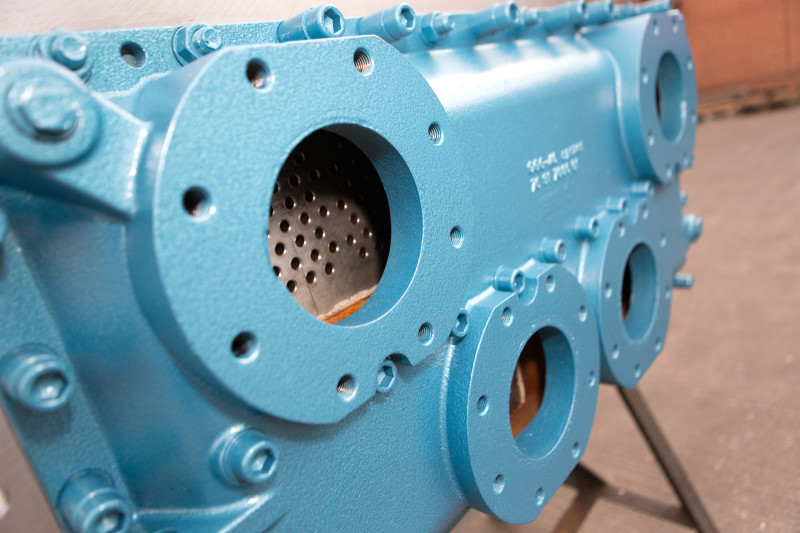
We usually supply the cooler element only, as water end covers outlast elements by many years, however, if you require a new return or nozzle cover, get in touch and we can fabricate a new set.
Charge Air Cooler Manufacturing
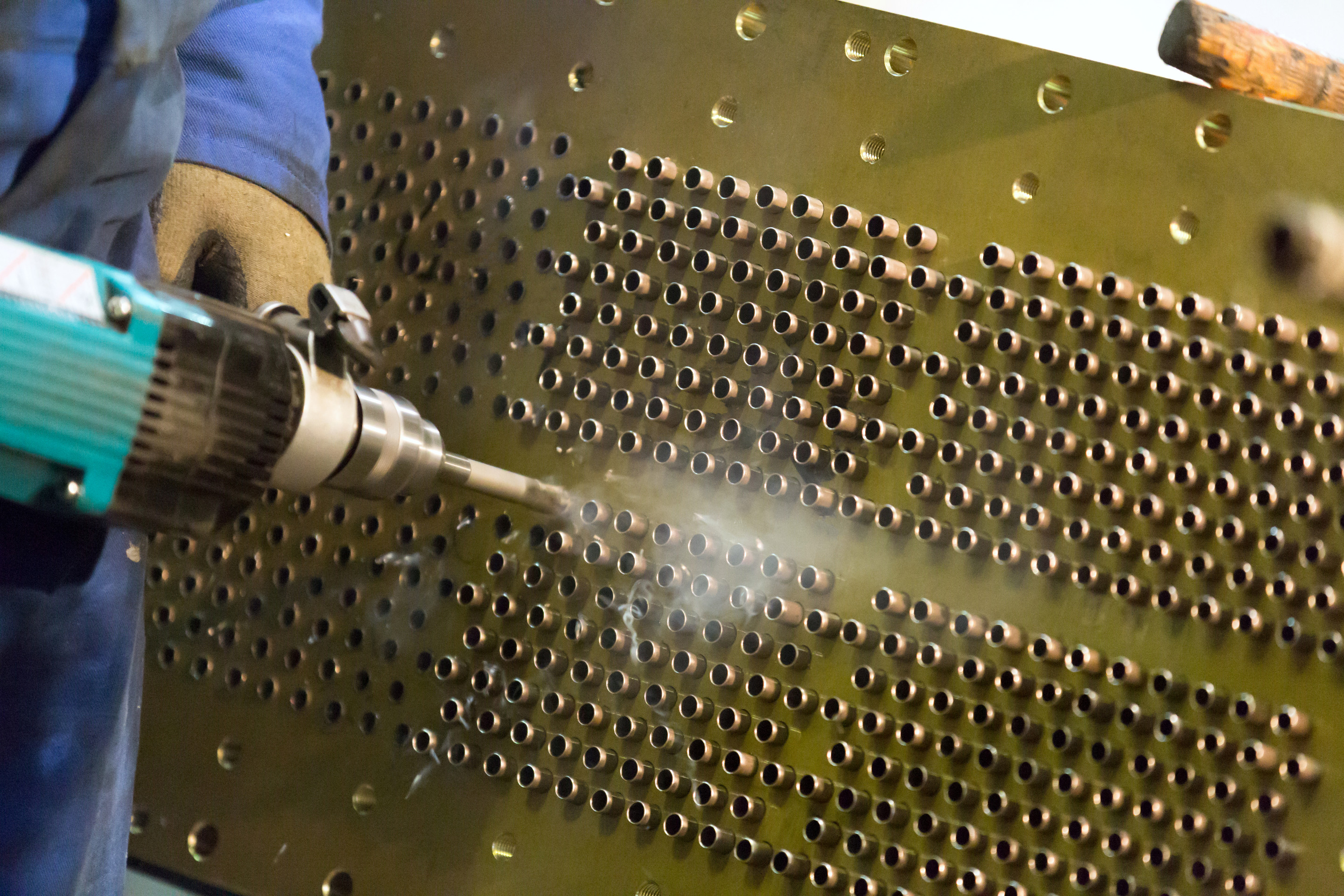
Here we see a technicia turning down excess tube length on the cooler, prior to final reaming of the tube end to give a flush quality finish.
Charge Air Cooler (CS Plates)
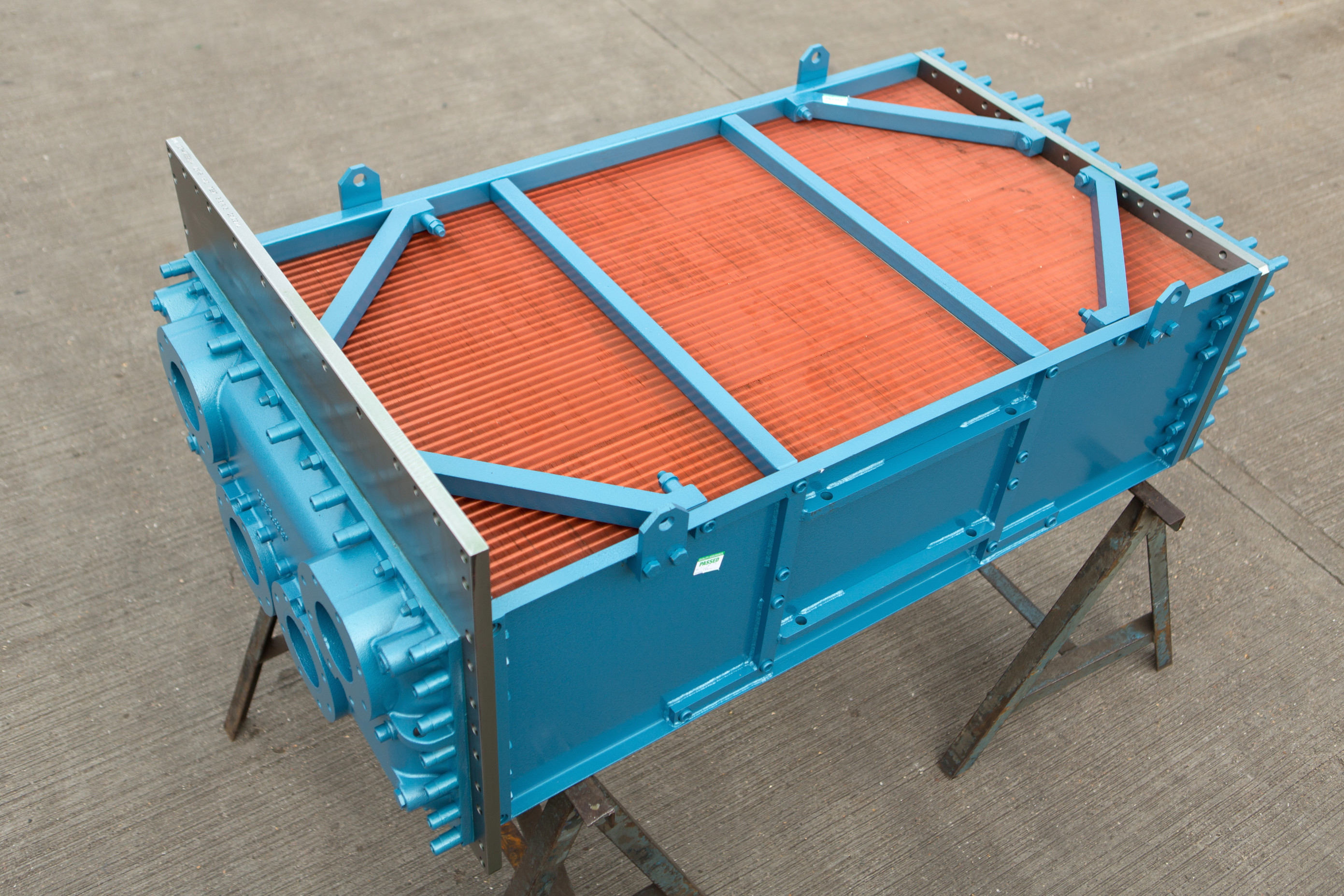
One of our newly manufactured carbon steel tube plate charge air coolers, ideally suited to fresh water application
FREQUENTLY ASKED QUESTIONS
What is a charge air cooler?
A charge air cooler is a heat exchanger that cools hot, compressed air from a turbocharger before it enters the engine. This cooling increases air density, allowing more fuel to be burned efficiently and increasing power output while reducing emissions.
Can I run my engine with a bad charge air cooler?
While an engine will run with a degraded charge air cooler, continued operation risks significant damage. Hot intake air reduces combustion efficiency, increasing exhaust temperatures that can damage pistons, rings, and valves. Fuel consumption increases and emissions worsen. We recommend immediate inspection and repair or replacement.
How do you know if your charge air cooler is bad?
Key symptoms include loss of power under load, low or dropping boost pressure, increased exhaust gas temperatures, poor fuel economy, excessive black smoke, hissing sounds from air leaks, oil seepage on the cooler core, and more frequent DPF regenerations.
What's the difference between a charge air cooler and an intercooler?
Technically, “charge air cooler” is the broader term for any cooler that cools intake air after turbocharger compression. “Intercooler” originally referred specifically to coolers between multiple compression stages. In practice, the terms are often used interchangeably, though “charge air cooler” is preferred in industrial and marine contexts.
What materials are charge air coolers made from?
AMI Exchangers manufactures charge air coolers in aluminium, copper, stainless steel and carbon steel. Material selection depends on operating environment, corrosion concerns, weight constraints, and thermal performance requirements. Marine applications typically use stainless steel or painted carbon steel for saltwater corrosion resistance.
How long does a charge air cooler last?
Service life varies based on operating conditions, maintenance, and material selection. Well-maintained charge air coolers in moderate environments can last 10-15 years or more. Marine and aggressive industrial environments may require more frequent replacement. Regular inspection and cleaning significantly extend service life.
Can you repair charge air coolers on-site?
Yes. AMI Exchangers provides worldwide on-board and on-site services including inspection, cleaning, re-tubing, and repair. Our mobile technicians carry specialised equipment and common spare parts, minimising the need to remove coolers from vessels or machinery.
Do you stock replacement charge air coolers?
No. AMI Exchangers maintains extensive stock holding of material for manufacturing CACs for many engine types used in marine, industrial, and rail applications. This enables rapid manufacturer and dispatch of replacement units, keeping downtime to a minimum. Every Cooler is made to the clients specifications and requirements.